Piezotechnology and PZT Materials
The Piezoelectric Effect, Piezo Ceramics and Piezo Actuators
The piezo effect is at the heart of many inventions that make our lives better and more secure.
What the Piezoelectric Effect Enables
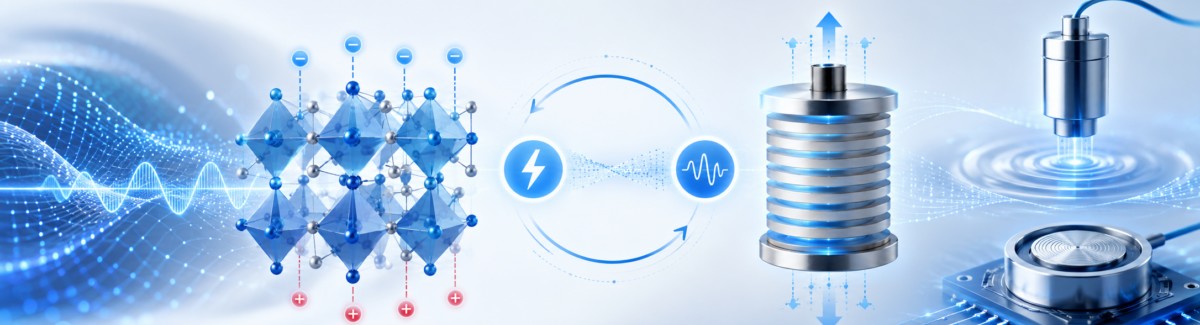
Piezoelectric ceramics are ferroelectric materials that convert electrical energy into mechanical motion and mechanical stress into electrical charge. This dual behavior is the basis for piezo actuators, sensors, ultrasonic transducers, precision dispensers, and energy-harvesting devices. In actuator applications, a voltage applied to a polarized piezoceramic changes the dimensions of the material by a very small but highly controllable amount. Because the motion is solid-state, piezo devices can generate sub-nanometer position changes without gears, screws, bearings, or magnetic motors.
Most industrial piezoceramics are based on PZT, a lead zirconate titanate material system - however leadfree piezo ceramics gain importance. The ceramic is manufactured, shaped, metallized, and polarized so that its internal domains are aligned in a useful direction. Material formulation, geometry, electrodes, preload, insulation, and packaging all influence the final performance. Hard piezoceramics are often preferred for resonant transducers and power ultrasonics, while softer piezoceramics are commonly used for precision linear actuators because they provide larger displacement at lower electric fields.
For precision motion, the piezoelectric effect enables fast response, high stiffness, high force, long lifetime, and extremely fine resolution. That is why piezo stacks, benders, tubes, shear plates, patch transducers, and flexure-guided actuators are widely used in microscopy, semiconductor metrology, medical devices, photonics, dispensing, vibration control, and industrial sensing.
Video – Piezo Manufacturing Process
Video – Piezo Manufacturing Process
Piezoelectric Effect Diagrams
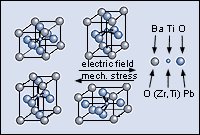
Cubic (paraelectric) and tetragonal (ferroelectric) structure of PZT and BaTiO3 before and after an electric field has been applied or a mechanical stress taken effect.
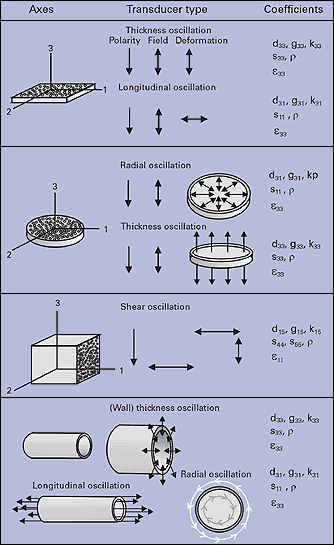
Representation of the electrical reorientation processes in piezoelectric ceramic crystallite and domain structure.
Where Piezo Technology Is Used
Precision Motion
Piezo stacks and flexure stages support nanopositioning, microscopy, photonics alignment and semiconductor metrology.
Sensing and Transducers
Piezo components can convert pressure, vibration or acoustic energy into electrical signals for medical and industrial sensors.
Ultrasonics and Dispensing
Hard piezoceramics and specialized geometries are used for ultrasonic transducers, nebulizers, valves and precision dosing systems.
Updated Resources
Where Piezo Technology is Used in High-Tech Industries and Everyday Products
Piezo technology is used wherever electrical energy must be converted into precise motion, vibration, sound, pressure measurement or ultrasonic energy. In high-tech industries, piezo components are often hidden inside advanced instruments and production equipment. In everyday products, the same physical effect is used in compact sensors, buzzers, igniters and ultrasonic motors.
Semiconductor and Photonics
Piezo nanopositioners align wafers, lenses, fibers, probes and photonic devices with nanometer precision for inspection, metrology, packaging and automated optical alignment.
Microscopy and Life Sciences
Piezo objective scanners, sample stages and fast focus drives enable high-resolution imaging, optical trapping, super-resolution microscopy and precise motion in biological experiments.
Medical and Ultrasonic Devices
Piezo transducers are used in ultrasound imaging, nebulizers, precision pumps, dosing systems and other compact devices that require efficient high-frequency motion.
Industrial Automation
Piezo actuators support fast valves, precision dispensing, vibration control, adaptive optics, laser beam control and sensor systems used in demanding production environments.
Automotive and Consumer Products
Piezo elements can be found in parking sensors, knock sensors, alarms, haptic devices, camera stabilization systems, microphones, speakers and compact acoustic components.
Everyday Utility Devices
Gas grill igniters, lighters, buzzers, humidifiers, toothbrushes and small ultrasonic cleaners often use piezo components because they are compact, reliable and efficient.
Piezo Technology Videos
Video – Micro Motors in Piezo Technology
Video – Piezo Technology Ultrasound Transducers for Automation
Video – Piezo Transducers for Industrial Printing
Video – Piezoelectric Transducers for Surgery, Medical Applications
Webinar: Piezo Transducers for Fluidics, Cytometry, Liquid Handling
Video - The Piezoelectric Effect in Motion Control
©1996-2012 PI (Physik Instrumente) LP. All rights reserved. Specifications subject to change without notice.